
ASTM A193 B8 Threaded Rods Temperature Rating & High-Heat Operating Limits: Complete Selection Guide
Choosing the right stainless steel fasteners for high-pressure, cryogenic, or high-temperature piping systems requires precise technical knowledge. Among all stainless steel threaded rods, AISI Grade 304 (commonly specified under ASTM A193 Grade B8) is widely recognized for its versatile performance and cost-effectiveness. However, operating beyond its safe temperature boundaries can lead to bolt relaxation, severe sensitization, or catastrophic flange leakage.
ASTM A193 B8 Threaded Rods
What is the exact working temperature range for 304 threaded rods? Where does the sensitization zone lie, and at what temperature does structural integrity drop? This comprehensive engineering guide breaks down the precise temperature ratings, metallurgical limits, and application guidelines for 304 stainless steel threaded rods (ASTM A193 B8 Class 1 and Class 2).
What is ASTM A193 B8 Threaded Rods?
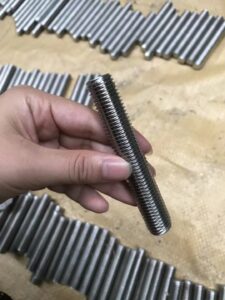
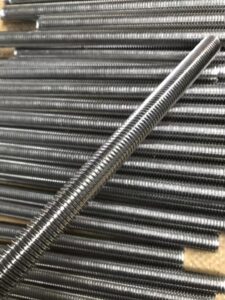
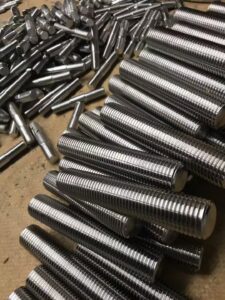
ASTM A193 Grade B8 specifies AISI 304 stainless steel fasteners designed for pressure vessels, valves, flanges, and high-temperature or high-pressure piping applications. Full-thread studs and threaded rods (manufactured to DIN 975, DIN 976, or ASME B18.31.3 standards) under Grade B8 are austenitic stainless steels offering superior toughness, excellent atmospheric corrosion resistance, and stable mechanical strength.
ASTM A193 B8 Threaded Rods
Austenitic stainless steels do not undergo a ductile-to-brittle transition, making them exceptionally tough across extreme thermal variations. However, temperature dictates both allowable working stress and corrosion resistance.
Complete Temperature Breakdown: From Cryogenic to Extreme Heat
https://tjzxcfastener.com/stainless-steel-full-threaded-bolts/
To select the correct threaded rod for your application, it is essential to understand how operating temperatures impact 304 material properties. We categorize the performance into four distinct thermal zones:
ASTM A193 B8 Threaded Rods
[-270°C to 425°C] —> OPTIMAL ZONE (Maximum strength, toughness, & corrosion resistance)
[425°C to 860°C] —> RISK ZONE (Sensitization & intergranular corrosion occur)
[870°C to 925°C] —> HIGH-HEAT ZONE (Short-term use only; non-load bearing)
[Above 925°C] —> EXTREME ZONE (Rapid degradation; not recommended)
Zone 1: -270°C to 425°C (-454°F to 797°F) — Optimal Operating Zone
This is the primary, safest, and most reliable working range for 304 / ASTM A193 B8 threaded rods.
Cryogenic Performance (-270°C to -29°C): Unlike ferritic carbon steels that become dangerously brittle at sub-zero temperatures, 304 austenitic steel retains high Charpy V-notch impact toughness even near absolute zero (-270°C / liquid helium environment). Tensile strength increases under sub-zero conditions without severe loss of ductility.
Standard Industrial Range (-29°C to 425°C): Provides the ultimate balance of yield strength, resistance to general atmospheric corrosion, and mechanical stability. It is the most common specification for flange connections, pressure valves, and industrial piping.
Zone 2: 425°C to 860°C (797°F to 1580°F) — Critical Sensitization Risk Zone
This temperature window is considered the danger zone for standard 304 stainless steel. Continuous exposure within this range must be strictly avoided or carefully managed.
The Sensitization Mechanism: Between 425°C and 860°C, carbon reacts with chromium along the grain boundaries to form Chromium Carbides (). This depletes chromium from the surrounding metal matrix below the 10.5% threshold required for passivation.
Result: The threaded rod becomes vulnerable to Intergranular Corrosion (IGC) and stress corrosion cracking under tensile loads.
Engineering Fix: For continuous service within this window, upgrade to ASTM A193 Grade B8L (low carbon 304L) or Grade B8C (Columbium-stabilized 347).
Zone 3: 870°C to 925°C (1598°F to 1697°F) — High-Temperature Upper Limit
This range represents the upper thermal boundary for 304 material scaling resistance.
Operational Constraints: Usable only for short-term or intermittent applications. While 304 offers acceptable oxidation scaling resistance up to 925°C, its yield strength and creep resistance drop drastically.
Structural Warning: Fasteners in this zone suffer thermal relaxation (loss of bolt preload). It is not recommended for load-bearing or pressure-retaining structural joints.
Zone 4: Above 925°C (> 1697°F) — Extreme Limit Zone
Operating 304 threaded rods above 925°C is considered an extreme limit condition.
Degradation: Heavy oxide scaling occurs rapidly, and mechanical load-carrying capacity drops to near zero.
Failure Mode: High thermal creep causes joint stretching, flange distortion, and rapid failure. High-nickel alloys (Inconel, Hastelloy) or ASTM A453 Grade 660 must be specified instead.
ASTM A193 B8 Threaded Rods
304 Threaded Rod Operating Matrix
Temperature Zone
Temperature Limits
Primary Application
Risk / Failure Mode
Recommended Grade
Optimal Zone
-270°C to 425°C
LNG, Cryogenics, Standard Piping
None (Safe Operating Window)
ASTM A193 B8 Class 1/2
Risk Zone
425°C to 860°C
Exhausts, Heat Exchangers
Chromium Carbide / IGC Attack
ASTM A193 B8L / B8C
High-Heat Zone
870°C to 925°C
Short-term Furnace Fixtures
Bolt Relaxation / Strength Loss
ASTM A193 B8M / 310S
Extreme Zone
> 925°C
Emergency Heat Exposure
Severe Oxidation / Creep Failure
ASTM A453 Grade 660
Class 1 vs Class 2 Mechanical Properties & Strength Retention of ASTM A193 B8 Threaded Rods
When specifying ASTM A193 Grade B8 threaded rods, selecting between Class 1 and Class 2 determines tightening torque and clamp force capacity:
Class 1 (Carbide Solution Annealed):
– Tensile Strength: 75,000 PSI (515 MPa) min
– Yield Strength: 30,000 PSI (205 MPa) min
– Elongation: 30% min
– Best for: High corrosion resistance, standard clamping force.
Class 2 (Carbide Solution Annealed & Strain Hardened):
– Tensile Strength: 100,000 to 125,000 PSI (690 to 860 MPa) min
– Yield Strength: 50,000 to 100,000 PSI (345 to 690 MPa) min
– Elongation: 12% to 15% min
– Best for: High-pressure flange joints requiring elevated bolt preloads.
Quality Assurance: How We Guarantee Material Integrity for ASTM A193 B8 Threaded Rods
For critical pressure-retaining applications, fastener compliance must be verified with full material traceability. Quality procedures include:
1. )100% Positive Material Identification (PMI): XRF analyzer inspection verifying Chromium (18.0-20.0%) and Nickel (8.0-10.5%) chemical composition prior to threading.
2.)Pitch Gauge & Dimensional Inspection: Thread dimensions checked per ASME B1.1 or ISO 68-1 tolerance classes.
3.)Traceability & Certification: Every batch stamped with heat numbers and accompanied by EN 10204 3.1 Mill Test Certificates (MTC).
Conclusion & Engineering Summary of ASTM A193 B8 Threaded Rods
Understanding thermal boundaries is crucial when purchasing 304 stainless steel fasteners. While -270°C to 425°C serves as the optimal operating zone for ASTM A193 Grade B8 threaded rods, elevated temperatures demand continuous monitoring of sensitization risks and mechanical load limits.
Need certified ASTM A193 B8 / B8M stainless steel threaded rods, stud bolts, or custom cut lengths for your piping project? Contact our engineering sales team today to request a rapid quote.
ASTM A193 B8 Threaded Rods
Pingback: Stainless Steel Stud Bolts for Valves: Why Valve Manufacturers Prefer This Fastener Solution - Stainless steel Fastener