
ASTM A193 B8 vs B8M Stud Bolts: Best Difference & Selection Guide
Selecting the right high-temperature and high-pressure fasteners for petrochemical, valve, or offshore applications is critical for structural safety. Among the most widely used ASTM specifications, **ASTM A193 B8 vs B8M stud bolts** are the two primary choices.
While both belong to the austenitic stainless steel family under the ASTM A193 specification, their chemical compositions, corrosion resistance, and mechanical classes differ significantly.
In this guide, we break down the key differences between ASTM A193 B8 and B8M stud bolts, compare Class 1 vs Class 2 performance, and provide clear selection criteria for your engineering projects.
ASTM A193 B8 vs B8M Stud Bolts: Complete & Accurate Selection Guide
1. ASTM A193 B8 vs B8M stud bolts: Chemical Composition Comparison
The core difference between ASTM A193 Grade B8 and Grade B8M lies in their base stainless steel alloys:
ASTM A193 B8: Manufactured from **AISI 304 stainless steel** (18% Chromium, 8% Nickel).
ASTM A193 B8M: Manufactured from **AISI 316 stainless steel** (16% Chromium, 10% Nickel, and 2-3% Molybdenum).
Why Molybdenum Matters in B8M
The addition of 2% to 3% Molybdenum in B8M significantly enhances its resistance to **pitting and crevice corrosion** in chloride-rich environments, such as seawater, marine atmospheres, and harsh chemical processing plants.
| Feature / Element | ASTM A193 B8 | ASTM A193 B8M |
| :— | :— | :— |
| **Base AISI Alloy** | AISI 304 Stainless Steel | AISI 316 Stainless Steel |
| **Chromium (Cr)** | 18.0% – 20.0% | 16.0% – 18.0% |
| **Nickel (Ni)** | 8.0% – 11.0% | 10.0% – 14.0% |
| **Molybdenum (Mo)** | None | **2.0% – 3.0%** |
| **Corrosion Resistance** | Excellent in general environments | **Superior in marine & chloride environments** |
| **Common Uses** | General industrial, food processing | Offshore oil & gas, marine, chemical valves |
ASTM A193 B8 vs B8M Stud Bolts: Complete & Accurate Selection Guide
— 2. Mechanical Properties: Class 1 vs Class 2: ASTM A193 B8 & B8M Stud Bolts
Both B8 and B8M stud bolts are available in two primary heat-treatment classes: **Class 1** and **Class 2**. Choosing the correct class determines the tensile and yield strength of your threaded fasteners.
### Class 1 (Carbide Solution Treated)
* **Process**: Annealed at high temperatures to restore maximum corrosion resistance.
* **Mechanical State**: Softened state with lower tensile and yield strength.
* **Best For**: Applications prioritizing maximum corrosion resistance over high tensile loading.
### Class 2 (Carbide Solution Treated & Strain Hardened)
* **Process**: Cold worked (strain hardened) after solution treatment to increase strength.
* **Mechanical State**: Significantly higher yield strength and tensile strength.
* **Best For**: High-pressure flange connections, heavy-duty valves, and pressure vessels.
> **Note for Engineers**: As the diameter of Class 2 stud bolts increases (above 3/4 inch), the tensile strength slightly decreases due to the depth limits of strain hardening. Always refer to the ASTM A193 standard specification chart during flange design.
ASTM A193 B8 vs B8M Stud Bolts: Complete & Accurate Selection Guide
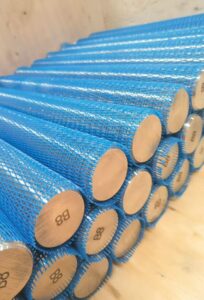
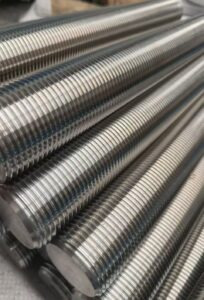
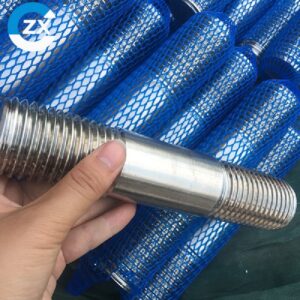
https://tjzxcfastener.com/stainless-steel-double-ended-bolts/
3. Temperature Limits and Application Scenarios
Both ASTM A193 B8 and B8M stud bolts are engineered for high-temperature and high-pressure service, often paired with **ASTM A194 Grade 8 or Grade 8M hex nuts**.
* **Choose ASTM A193 B8 if**:
* Your application involves general high-temperature piping or industrial pressure vessels.
* The environment is non-marine and lacks exposure to heavy chlorides or harsh acids.
* Cost efficiency is a priority without sacrificing standard stainless steel performance.
* **Choose ASTM A193 B8M if**:
* Fasteners are installed in offshore oil rigs, subsea equipment, or coastal facilities.
* Piping systems transport corrosive chemicals, acids, or marine fluids.
* Long-term pitting resistance is required under high pressure.
—
## 4. How to Specify Custom ASTM A193 B8 & B8M Stud Bolts
When requesting a quotation from a stainless steel stud bolt supplier, providing complete technical specifications prevents delay and ensures accurate manufacturing:
1. **Exact Grade & Class**: e.g., *ASTM A193 Grade B8 Class 2* or *ASTM A193 Grade B8M Class 1*.
2. **Dimensions & Thread Pitch**: Diameter, length (UNC, UNR, or Metric threads as per ASME B18.31.2 or DIN standards).
3. **Mating Hardware**: Specify matching nuts (e.g., ASTM A194 Grade 8/8M) and washers.
4. **Surface Finish**: Plain, passivated, or PTFE/Xylan coated for anti-galling.
5. **Certification Requirements**: Mill Test Certificate (MTC) conforming to **EN 10204 3.1**, PMI (Positive Material Identification) testing, or 3rd party inspection (SGS/TÜV).
—ASTM A193 B8 vs B8M Stud Bolts: Difference & Selection Guide
## Need Custom ASTM A193 B8/B8M Stud Bolts for Your Project?
As a specialized China manufacturer and supplier of stainless steel fasteners, we provide precision-engineered **ASTM A193 B8 and B8M stud bolts, full thread rods, U-bolts, and hex bolts**.
We support full OEM customization, custom lengths, special thread pitches, and complete **EN 10204 3.1 Mill Test Reports** with fast global delivery.
* **Material Options**: SS304, SS316, B8, B8M, B8 Class 2, B8M Class 2, Duplex Stainless Steel.
* **Standards**: ASTM A193, ASME B18.31.2, DIN 975, DIN 938/939.
**Have a drawing or BOQ to quote?** Contact our technical sales team today for a fast competitive quote within 12 hours!
ASTM A193 B8 vs B8M Stud Bolts: Complete & Accurate Selection Guide