
B8 stainless steel stud bolt
Many procurement engineers and plant maintenance personnel run into costly headaches with B8 stainless steel stud bolt.
Flange joint leakage after startup, fastener unexpected pitting corrosion, wrong mechanical strength leading to stud elongation, project rework caused by confusing Class 1 / Class 2 specifications, or pairing with unsuitable nuts are widespread real‑world pain points.
These avoidable mistakes trigger unplanned equipment shutdown, safety risks and extra procurement expenses.
This guide is built around actual field failure cases, helping you pick, specify and deploy B8 stainless steel stud bolt without typical costly errors.
1. Most Common Pain Points When Using B8 Stainless Steel Stud Bolt
Most failures of B8 stainless steel stud bolt are not material defects, but specification misunderstanding and improper application. Four frequent issues repeatedly trouble industrial projects.
First: Purchasing B8 studs without clarifying Class 1 or Class 2. Many buyers only mark “B8 stud bolt” on PO. Suppliers may deliver low‑strength Class 1 for high‑pressure flange joints, resulting in stud stretching, gasket decompression and fluid leakage.
Second: Misjudging corrosion resistance. Users treat B8 as universal anti‑corrosion fasteners and apply them in high‑chloride coastal environments, suffering pitting and stress‑corrosion cracking even with stainless material.
Third: Mismatched supporting nuts. B8 studs require matching ASTM A194 Grade 8 heavy hex nuts. Ordinary standard nuts will cause thread damage and uneven pre‑load under working pressure.
Fourth: Over‑torque installation. Stainless steel threads easily gall under excessive tightening torque, damaging thread teeth and reducing long‑term joint reliability.
2. ASTM A193 B8 Basics: Class 1 vs Class 2 — Avoid Specification Pitfalls
B8 stainless steel stud bolts belong to ASTM A193 standard, made from AISI 304 austenitic stainless steel. Two mechanical classes serve totally different working conditions, and mixing them is a major safety hazard for pressure‑vessel and piping systems.
You can check the complete technical parameters and classification specifications via the official ASTM A193 standard document to avoid specification selection errors.
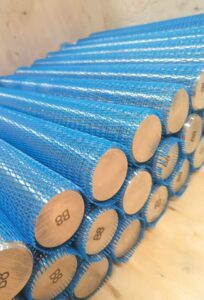
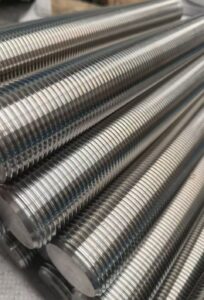
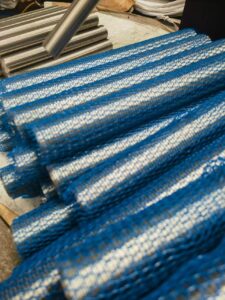
2.1 B8 Class 1
Solution‑annealed status, lower tensile and yield strength. Fit for low‑pressure, low‑pre‑load static connection scenarios where corrosion‑resistance is the main requirement, not high mechanical stress.
Never substitute Class 1 for Class 2 on high‑pressure flanges.
2.2 B8 Class 2
Solution‑annealed plus strain‑hardened treatment, greatly improved tensile and yield performance. Widely used for pressure‑vessel, valve and critical‑flange bolting joints.
Note that mechanical performance drops for larger‑diameter sizes; check official ASTM data for your exact dimension.
3. Material‑Selection Pain Point: When to Choose B8, When to Upgrade to B8M
A widespread misunderstanding: all stainless‑steel studs resist all corrosive conditions. B8 stainless steel stud bolts perform well for atmospheric, general chemical and food‑processing environments, yet they show weaknesses under chloride‑rich marine or coastal service.
3.1 Stick with B8 (304‑based)
Select ASTM A193 B8 when working conditions are indoor, fresh‑water exposure, general organic‑chemical medium, food‑processing equipment and non‑coastal plant facilities. It balances reliable corrosion resistance and competitive procurement cost.
3.2 Upgrade to B8M (316‑based)
Pick B8M (molybdenum‑added 316 stainless variant) for coastal splash zones, salt‑spray atmosphere and moderate‑chloride process media. Remember that B8M still cannot fully prevent chloride stress‑corrosion cracking under heavy continuous salt‑load offshore service, and further engineering assessment is needed for extreme offshore projects.
4. Correct Matching: Nuts, Gaskets and Application Scenarios
Even qualified B8 stainless steel stud bolts deliver poor performance if supporting accessories are wrong. Below are typical applicable scenarios and supporting‑part rules for your procurement checklist.
4.1 Recommended Matching Hardware
Always pair B8 studs with ASTM A194 Grade 8 heavy hex nuts. Use suitable stainless or non‑metallic flat washers to spread compression stress. Anti‑seize compound for stainless‑steel threads is strongly advised to prevent thread galling during assembly and future disassembly.
4.2 Core Industrial Applications for B8 Stud Bolts
‑ Petrochemical plant non‑high‑chloride piping flanges, valve bonnet connections ‑ Food & beverage processing sanitary equipment ‑ Power‑plant auxiliary equipment and heat‑exchanger bolting ‑ Cryogenic‑service equipment complying with relevant code requirements ‑ General‑industry pressure‑vessel cover‑plate fastening
5. Installation Best Practices: Prevent Galling, Leakage and Pre‑load Loss
Field installers frequently damage B8 stainless steel stud bolts due to torque misuse. Stainless steel threads are prone to cold‑welding (galling) under fast high‑torque tightening, which destroys thread integrity before reaching target pre‑load.
First, apply proper anti‑seize lubricant designed for stainless‑steel fasteners.
Second, adopt step‑by‑step cross‑torque tightening sequence for flange joints, do not single‑screw one nut to final torque at one time.
Third, strictly follow project‑specified torque values; do not arbitrarily raise torque for “safer clamping”.
Fourth, inspect thread condition before assembly; reject studs with dent, scratch or burr on threads.
6. Sourcing Custom & Standard B8 Stainless Steel Stud Bolt
Many purchasers face sourcing troubles: suppliers deliver mixed‑class goods, incomplete material test reports, or cannot provide non‑standard length / thread‑form studs for special equipment retrofitting.
We supply standard and custom‑built B8 stainless steel stud bolt including Class 1 and Class 2 specifications, complying fully with ASTM A193 standards. Complete material test reports (MTR) can be provided for industrial‑project quality traceability.
We also support B8M stud‑bolt variants, matched A194 Grade 8 nuts and washers for one‑stop procurement. Whether you need small‑batch samples or bulk wholesale for petrochemical, food‑processing or pressure‑vessel projects, contact us for detailed dimension lists and formal quotations.